Quick Answer
Retaining walls fail in East Tennessee because of water, not dirt. Our clay drains slowly, so hydrostatic pressure builds up behind the wall, and freeze-thaw cycles make it worse by freezing and expanding that trapped water all winter. A wall that lasts needs a proper footing below frost depth, gravel backfill instead of native clay, a drainage or weep system, and geogrid reinforcement for taller walls.
- East Tennessee clay drains slowly, so water collects behind a wall as hydrostatic pressure instead of running off, and freeze-thaw amplifies it by freezing and expanding that trapped water.
- A wall that lasts needs a proper footing below frost depth on compacted aggregate, gravel backfill (not native clay) behind the wall, a drainage pipe or weep system at the base, and geogrid reinforcement for taller walls.
- Walls over a certain height require engineering, often by code.
- Warning signs of a failing wall: leaning or bulging, cracks or separation between blocks, soil or mulch washing out from behind it, and water seeping through the face after rain.
What actually destroys retaining walls in East Tennessee?
Water pressure building up behind the wall in heavy clay, not the soil itself. Freeze-thaw cycles make it worse.
Do all retaining walls need an engineer?
Walls over a certain height require engineering, often by code. All walls, regardless of height, still need proper footing, drainage, and backfill.
A Retaining Wall's Real Enemy Is Water, Not Dirt
People assume a retaining wall just holds back soil. What actually destroys walls in East Tennessee is water pressure building up behind them in our heavy clay. When that water can't escape, it pushes, and over a few seasons the wall leans, bulges, cracks, or fails outright.
Why East TN Clay Is So Hard on Walls
- Clay holds water. Our red clay drains slowly, so water collects behind a wall instead of running off. That's hydrostatic pressure, and it's relentless.
- Freeze-thaw amplifies it. Trapped water freezes and expands against the wall all winter.
- Slopes concentrate it. On the sloped lots common here, a wall is often holding back both soil and a lot of moving groundwater.
What Makes a Wall Actually Last
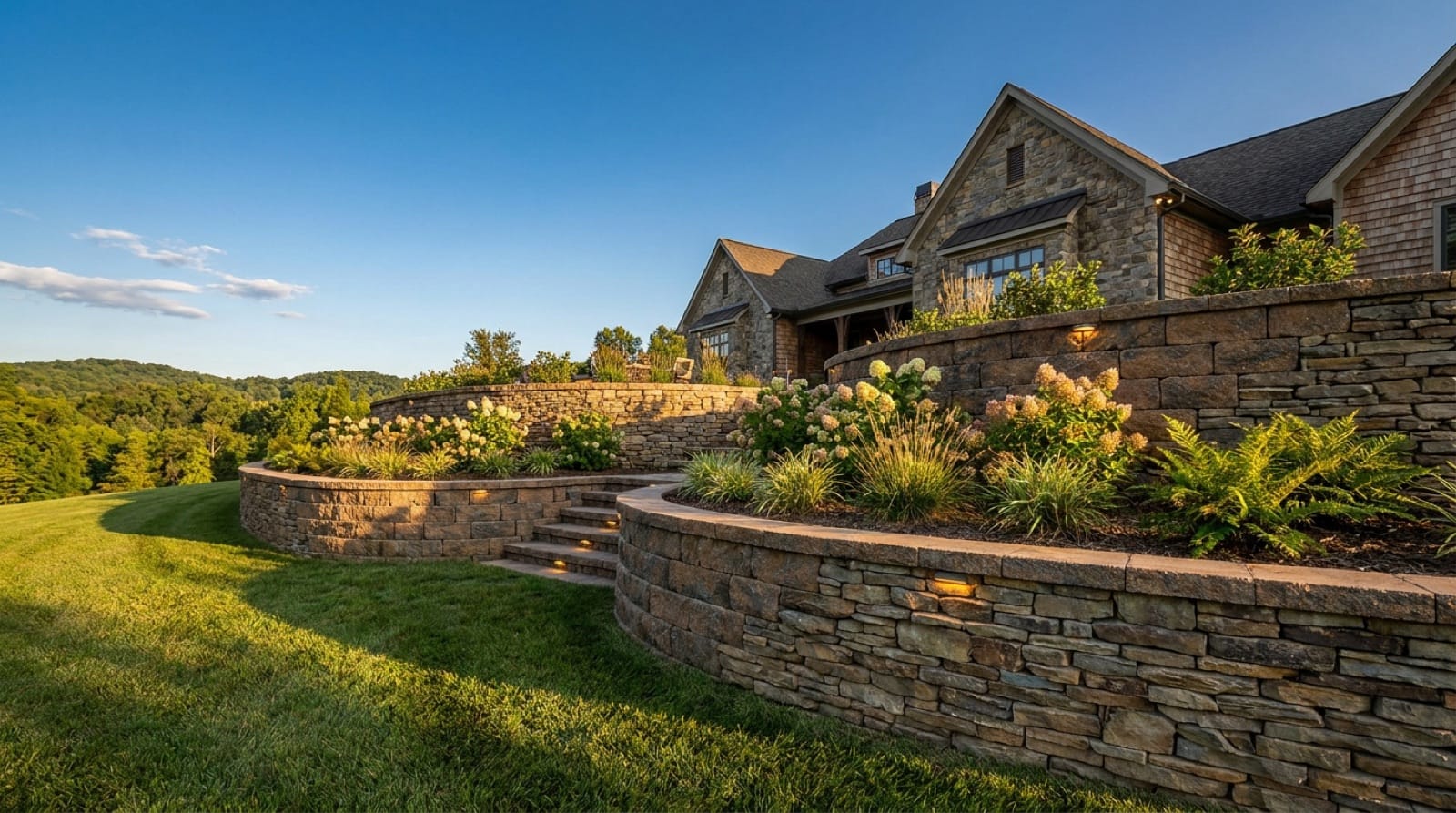
A retaining wall that survives here isn't about stacking heavier block. It's about engineering and drainage:
- A proper footing/base below frost depth on compacted aggregate.
- Gravel backfill behind the wall, not the native clay, so water can move.
- A drainage pipe (weep system) at the base to carry water away instead of letting it build up.
- Geogrid reinforcement tied back into the slope for taller walls, so the wall and the hill work as one mass.
- Engineering for walls over a certain height (often required by code).
Skip the gravel and the drain, and even a beautiful wall is on borrowed time.
Signs a Wall Is in Trouble
- Leaning, bulging, or a wall that's no longer plumb
- Cracks or separation between blocks
- Soil or mulch washing out from behind or below it
- Water seeping through the face after rain (this one's actually a sign the drainage is at least partly working, or overwhelmed)
Build It Right the First Time
A retaining wall is structural. Done right, it lasts decades and doubles as beautiful terraced living space; done cheap, it's a teardown. We engineer drainage and reinforcement into every wall for our soil. See the retaining wall cost guide, get an estimate, or request a free phone consultation.
Christopher Morales
Co-founder of Morales Outdoor Living. 16+ years designing and building pools, patios, decks, and complete outdoor living spaces across East Tennessee. TN License #77919.
Meet the teamLike this guide? Add Morales Outdoor Living as a preferred source on Google.